Chatrium Hotels & Residences

Chatrium Hotels & Residences provides uncompromising, warm service and a captivating experience in stunning surroundings, from cosmopolitan city living in Bangkok to the relaxing beauty of Royal Lake in Yangon, for long or short term stays.

Chatrium Hotel Riverside Bangkok
This multiple award-winning, five-star hotel situated by the legendary Chao Phraya River offers truly breathtaking views. A selection of 396 spacious rooms, each with a choice of river or city views, offers a private balcony, a convenient kitchenette and state-ofthe-art technology in entertainment and connectivity. The Chatrium Club Lounge provides exclusive services, adding an extra touch of luxury. The six restaurants and bars are amongst the best in Bangkok. Guests can keep active at the fully equipped fitness centre, relax by the infinity pool or be pampered at Nemita Spa.

Emporium Suites by Chatrium
A five-star luxury hotel and residence in one of Bangkok’s most prestigious addresses and winner of TripAdvisor’s Travelers’ Choice Award, Emporium Suites is situated above Emporium Shopping Complex and next to Emquartier and Benjasiri Park. There are 378 elegantly appointed rooms featuring floor-to-ceiling windows offering beautiful cityscape panoramas, kitchenettes or separate kitchens, the highest quality furnishings and unparalleled service. Dining combines delicious international cuisine with stunning city views, whilst cocktails can be sipped poolside at the Pool Bar. Stay fit at the modern fitness centre, with both male and female steam and sauna rooms, before getting down to business in one of five meeting rooms.

Chatrium Residence Sathon Bangkok
Discover a sanctuary away from the hustle and bustle of Bangkok whilst still only minutes away from trendy shopping areas. Chatrium Residence Sathon Bangkok offers 560 rooms and suites, each with a kitchenette or separate kitchen, spacious bathrooms, homely furnishings and daily housekeeping services. You’ll find everything you need from three superb restaurants and bars, a minimart, selfservice launderette, kids’ play area, a resort-style lagoon swimming pool, spa and driving range.

Maitria Hotel Sukhumvit 18 – A Chatrium Collection
A modern lifestyle hotel in the downtown district of Bangkok, Maitria Hotel Sukhumvit 18 – A Chatrium Collection provides a unique lifestyle experience that’s tailored to the savvy traveller. Each of the 131 guestrooms has been crafted to provide you with modern living spaces and is fitted with sleek designer furnishings and state-ofthe-art technology in both entertainment and connectivity. Metta Eatery & Bar, the exciting long table eatery concept restaurant, is the perfect place togather to enjoy authentic tastes with modern twists from traditional Thai dishes to Western flavours.

Chatrium Residence Riverside Bangkok
This five-star serviced home-away-fromhome is situated beside the Chao Phraya River, where stunning views complement new heights in comfort and convenience. Spacious residences offer all the comforts of home and private balconies provide beautiful views of the Chao Phraya River and Bangkok cityscape, whilst a choice of one, two and three bedroom residences offer ample living space.

Chatrium Golf Resort Soi Dao Chanthaburi
Discover a breathtaking highland sanctuary at Chatrium Golf Resort Soi Dao Chanthaburi. Set amidst 1600 acres of lush greenery with stunning vistas of the imposing Soi Dao Mountain, the Denis Griffith’s- designed 18-hole international class course was recently upgraded by Golf East and is complemented by 47 opulent guestrooms with balconies overlooking the tranquil green, a Club House featuring Soi Dao restaurant, a fully-stocked Pro Shop and expansive outdoor pool.

Chatrium Hotel Royal Lake Yangon
One of the city’s topmost hotels for pure luxury, Chatrium Hotel Royal Lake Yangon is popular with many of the world’s celebrities and VIPs.

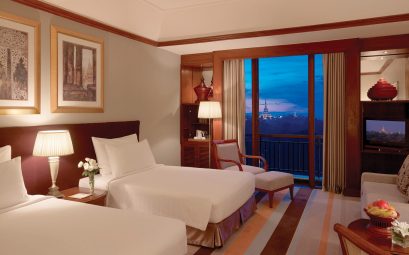
With simply stunning views of Kandawagyi Lake and the Shwedagon Pagoda, each of the 300 guestrooms offer a unique sense of escape. You’ll find state ofthe-art technology for in-room connectivity and entertainment blended seamlessly with charming decor and furnishings.

Choose from six restaurants and bars, relax by the beach-style swimming pool, work-out at the fitness centre and rejuvenate at Nemita Spa.

The Grand Ballroom is ideal for weddings, banquets and large events, with smaller meeting rooms available for more private functions.

For more information or reservations, please call Chatrium Hotel Riverside Bangkok on +66 2307 8888, Chatrium Hotel Royal Lake Yangon on +95 1544 500, Emporium Suites by Chatrium on +66 2664 9999, Chatrium Residence Sathon Bangkok on +66 2672 0200, Chatrium Residence Riverside Bangkok on +66 2307 8888, Chatrium Golf Resort Soi Dao Chanthaburi on +66 89 9343008 and Maitria Hotel Sukhumvit 18 – A Chatrium Collection on +66 2302 5777.
Bohol Beach Club

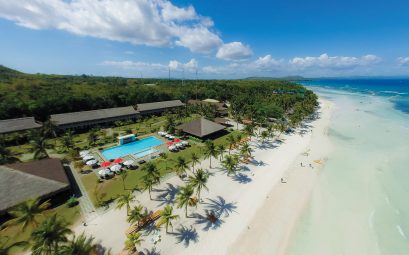
Far from the maddening crowd and unwanted distractions, Bohol Beach Club boasts the best private beach on the island with pristine waters and powdery, white sand; perfectly swimmable and ideal for snorkelling and scuba diving.

Peace, serenity and privacy are guaranteed within the well-designed property. Whatever purpose it may be, whether for a day filled with activity or a quiet laid back lifestyle, the resort is sure to deliver.

Bohol Beach Club has a total of 88 rooms consisting of 20 Deluxe Rooms, 60 Deluxe Green (eco-friendly) Rooms and eight Beachview Suites. All rooms in the Deluxe category have an impressive view of the swimming pool and beach, while all of the suites have a unique view and easy access to the beach.

All rooms are spacious and bright with a contemporary design that preserves a touch of Filipino elements with the prolific use of wooden furniture and local handicrafts. The generously sized rooms include a choice of bed configurations, a flat-screen TV, separate shower and tub (for the Beachview suites), as well as a veranda with deck chairs. Wi-Fi access, premium toiletries and a minibar are also available in all rooms. For guests with special needs, easy access rooms are available in both rooms and suites, while pet-friendly rooms are available in the Deluxe category.

Transportation requirements such as airport/city transfers, car hire with driver, guided tours and vehicle rentals from cars to buses can be arranged with ease. Speedboat and banca boat rental, island hopping, water activities and scuba diving can be easily organised through the in-house Club Aquasports shop.

Aside from the resort’s rooms, amenities and activities, Bohol Beach Club is proud to provide some of the best food on the island. Menus have been thoughtfully prepared with a wide variety of traditional Filipino and international cuisine as well as an array of cocktails, fresh fruit shakes and a selection of wines. In-room dining is also made available, should you prefer this.

With impeccable service and genuine Filipino hospitality that comes straight from the heart, Bohol Beach Club aims to deliver a lasting impression.

Java

Java is Indonesia’s political and economic heart. It is home to the nation’s capital, Jakarta, and is proud of its well-preserved cultural traditions. It is blessed with mesmerising natural beauty, abundant wildlife and fascinating monuments of human civilisation.

Home to over 140 million people and the most populated island on the planet, Java has everything travellers could want. Its natural beauty is breathtaking with ever changing scenery that stretches from rice paddies to the sandy shores of beautiful beaches. It has active volcanoes and dense rainforests that contrast sharply to its cities.

While Jakarta is the capital of Indonesia, Central Java is considered its historic heartland. Among many places of interest is Yogyakarta, one of Indonesia’s most liveable and lovable cities, with street art, galleries, coffee shops and cultural attractions everywhere you look. It’s also a perfect base for Indonesia’s most important archaeological sites, Borobudur and Prambanan. Borobudur is one of the world’s most impressive temples and was built in about 800AD in the form of a stepped pyramid. Reaching 35 metres at its highest point, it features nearly 1500 carved story panels and 504 statues of Buddha. The vast structure was abandoned and lay hidden under foliage and volcanic ash for centuries before being rediscovered in the 1800s and is now a World Heritage Site.

About 90 kilometres north of Jepara in the central region, the dazzling offshore archipelago of Karimunjawa, a marine national park, consists of 27 coral-fringed islands, only five of which are inhabited. The white-sand beaches are sublime, swimming is wonderful and the pace of life as relaxed as a destination defined by coconut palms and turquoise seas should be.

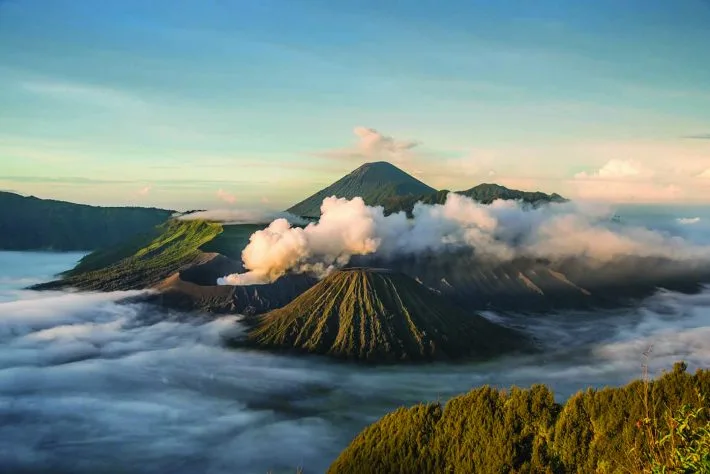
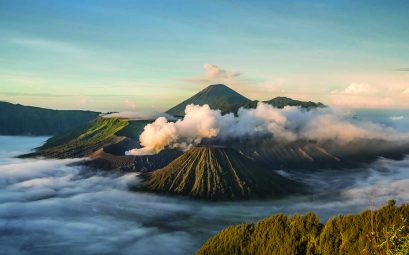
In the east, Surabaya is a a gateway city for Mount Bromo and Bali. Mount Bromo is a part of the Bromo Tengger Semeru National Park. While it may be small when measured against other volcanoes in Indonesia, the magnificent Mount Bromo will not disappoint with its spectacular views and dramatic landscapes.

Travel within Java can be laborious and particularly so in the west though the rail network is quite reliable and efficient. However, it is well worth the effort to see the sights and gain an understanding of the fascinating local culture that is wonderfully expressed through art, music and dance.

Cook Islands

The Cook Islands lie in the centre of the Polynesian triangle and are now easily reached from Australia with direct service from Sydney (6 hours) or via Auckland with Air New Zealand and Jetstar. From Rarotonga, Hawaiian Airlines offers direct flights to Hawaii while Air Rarotonga and Air Tahiti offer flights to Tahiti.

The group is made up of 15 islands, scattered over two million square kilometres of the Pacific Ocean. They fall into two distinct groups. The Southern Group comprises nine islands including the capital, Avarua in Rarotonga, where the majority of the population resides. Domestic travel to the outer islands is provided by Air Rarotonga and six of the nine islands are accessible by regular air services. The more remote Northern Group has six islands, three of which, Manihiki, Penrhyn and Pukupuka, are accessible by air (chartered flights only).

Capital and major centres
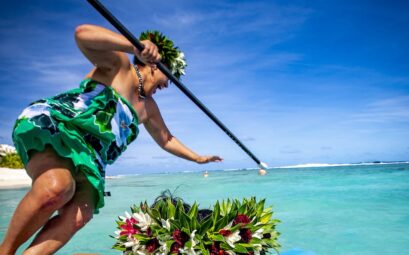
Vibrant and lively, Rarotonga is a hive of activity, and its circular shape is dominated by high mountain peaks from which lush rainforests cascade to the palm-fringed shore. All visitors are welcomed at the Rarotonga International Airport with the warm local greeting Kia Orana (Greetings, may you live on) and a fragrant flower garland or ei.

Avarua is the main town on Rarotonga and has a great selection of shops, cafes and restaurants located around the island. From Rarotonga you can visit the Sister Islands such as Aitutaki, famous for its spectacular white sand beaches and azure lagoons, only a 40-minute flight away on Air Rarotonga, with several flights daily.

Atiu, northeast of Rarotonga, offers untouched beaches and coral reefs riddled with caves. Mangaia is surrounded by a narrow fringing reef backed by the formidable cliffs of makatea (raised coral) that reach heights of up to 60 metres. Mauke has caves located in the cliffs of the coral reef and Mitiaro offers subterranean pools and
freshwater lakes that are full of itiki (freshwater eels), a local delicacy.

The People
Cook Islanders are of Polynesian descent and are called Cook Island Maori. They are culturally and linguistically similar to Tahitians and New Zealand Maori and are an open, friendly people, happy to share their lifestyle.

Nature
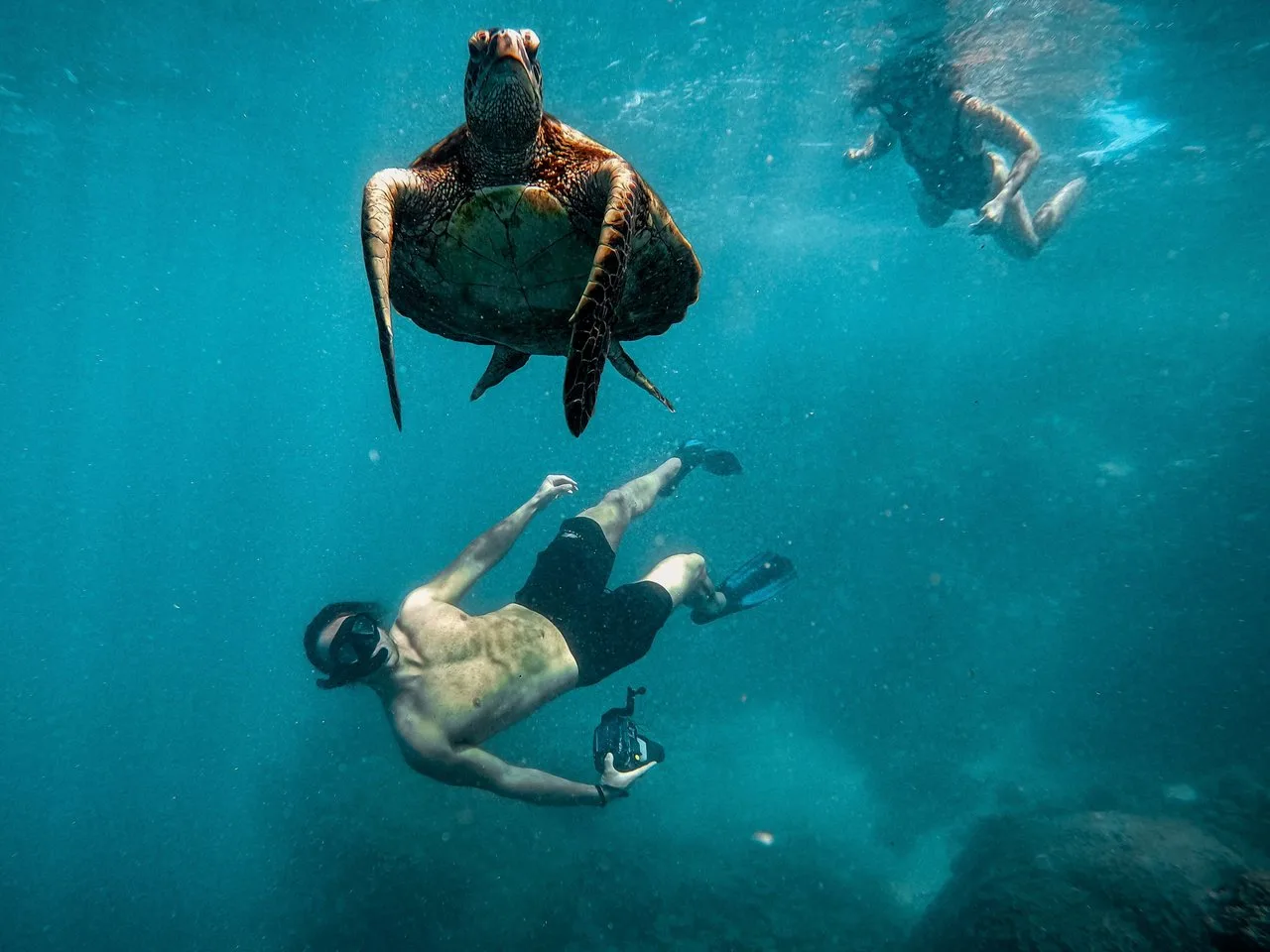
The Cook Islands host a diverse range of flora and fauna. Marine turtles can be found in some of the outer islands and humpback whales can be sighted from July through to October. A protective reef encircles the islands. The lagoons play host to a variety of vivid and interesting coral and marine life. The Cook Islands has an interesting range of geological structures, from the high volcanic peaks of Rarotonga (653 metres) to the raised coral structure of Mangaia and Atiu and the coral atoll structures of the Northern Group.

The sights
The six CICC Churches around Rarotonga are magnificent landmarks built of coral and lime and well worth a visit, particularly on Sunday. Most people attend church, and the air is vibrant with their beautiful singing called imene tuki. The ruins of the old Sunday School, built by the missionaries, have been renovated and are now the Beachcomber Pearl and Art Gallery. In the harbour, remnants of the wreck of the SS Maitai that was sunk in 1916 remain and its main engine still protrudes from the reef. You can trek through the Takuvaine/Avatiu valleys to see tropical vegetation or visit the Marae ‘Arai te Tonga’, a stone structure forming the royal court of the reigning ariki (high chief).

Where to stay
Rarotonga has a wide and varied selection of accommodation from first-class hotels and resorts, luxury villas and self-catering individual bungalows to backpacker facilities.

Aitutaki has a varied choice of accommodation, similar in quality to Rarotonga. Atiu has a varied but smaller selection of backpacker to mid-range accommodation available. Only basic needs are met on the islands of Mauke, Mitiaro (which has a homestay operation) and Mangaia.

Visiting more than Rarotonga
All major inhabited islands are accessible by air. There are more than three daily flights from Rarotonga to Aitutaki. Flights to Atiu, Mangaia, Mauke and Mitiaro are scheduled many times a week. Atiu is recognised as the third island to visit in the Cook Islands behind Aitutaki and three times a week there is a convenient triangle air route around the three islands of Rarotonga, Aitutaki and Atiu. Air Rarotonga and Air New Zealand also have a code share agreement that allows you to book an international flight direct to and from Aitutaki that can be combined with the triangle route to reduce even more travel time.

In Mauke, you can explore the jungle-covered limestone rocks to find the famous Maire plant and organic tropical garden lush with fruit. Discover Mitiaro and its village home-stay and live with a local family in a traditional thatched roof hut. Mitiaro is ringed with beach coves and underground swimming caves with natural healing properties. Mangaia is dominated with raised limestone coral and has numerous caves that stretch into giant underground caverns. At 18-million plus years, it is believed to be one of the oldest in the Pacific.

Getting around
Rarotonga is only 32 kilometres in circumference and one main road encircles the entire island, making it fairly easy to get around. Cook’s Buses, the local bus service, offers great public transport operating around Rarotonga in both directions, on regular day and evening schedules. The clockwise or anti-clockwise bus will pick you up and set you down anywhere on request.

Vehicles are driven on the left-hand side of the road. By law, safety helmets must be worn by all visitors for both drivers and passengers. Drivers of all types of vehicles are required to have either a current international licence or a Cook Islands driver’s licence which can be obtained from the Police station in downtown Avarua.

Food and entertainment
Nightspots and bars will, on occasion, have live entertainment. A highlight of the Cook Islands is the Polynesian feast, umukai, prepared in the traditional style with foods such as ika mata (marinated fish with coconut sauce), eke (octopus), taro (tuba vegetable), rukau (cooked taro leaves similar to spinach), and kumara (sweet potato). An umukai is usually part of an island night show featured at major hotels. The delectable buffet and traditional dancing are all part of the culture of the Cook Islands, and you can also experience this at the Highland Paradise and Te Vara Nui cultural attractions.

Wining and dining in Rarotonga is a treat with many excellent restaurants offering local and international cuisine in some very romantic locations.


Activities and shopping guide
There are a variety of activities on offer to suit any traveller. Relaxing lagoon cruises are available on two of the world’s most beautiful lagoons, Muri Lagoon on Rarotonga and the world famous Aitutaki
Lagoon. Popular pastimes include sailing, windsurfing, stand-up paddle boarding, snorkelling and scuba diving. Boats are available for charter for deep-sea and game fishing. Shops are open 8am to 4pm Monday to Friday, and 8am to noon on Saturdays. On Saturday mornings the popular local marketplace, Punanga Nui, in downtown Avarua offers a range of tropical delicacies and local craft items.

Climate and clothing
Warm and sunny all year round. Rainy season is December to March. Average summer temperature is 26 oC. Casual brief swimwear should be kept for beaches or poolside. Nude and topless sunbathing are unacceptable.

Currency
The NZ dollar, supplemented by local coinage (not negotiable outside the Cook Islands). The dollar coin bearing the symbol of the traditional god, Tangaroa, is popular with coin collectors, as is the $3 note. There are ATMs located on Rarotonga and Aitutaki. EFTPOS is available. Tipping is not customary but is appreciated.

Chuuk

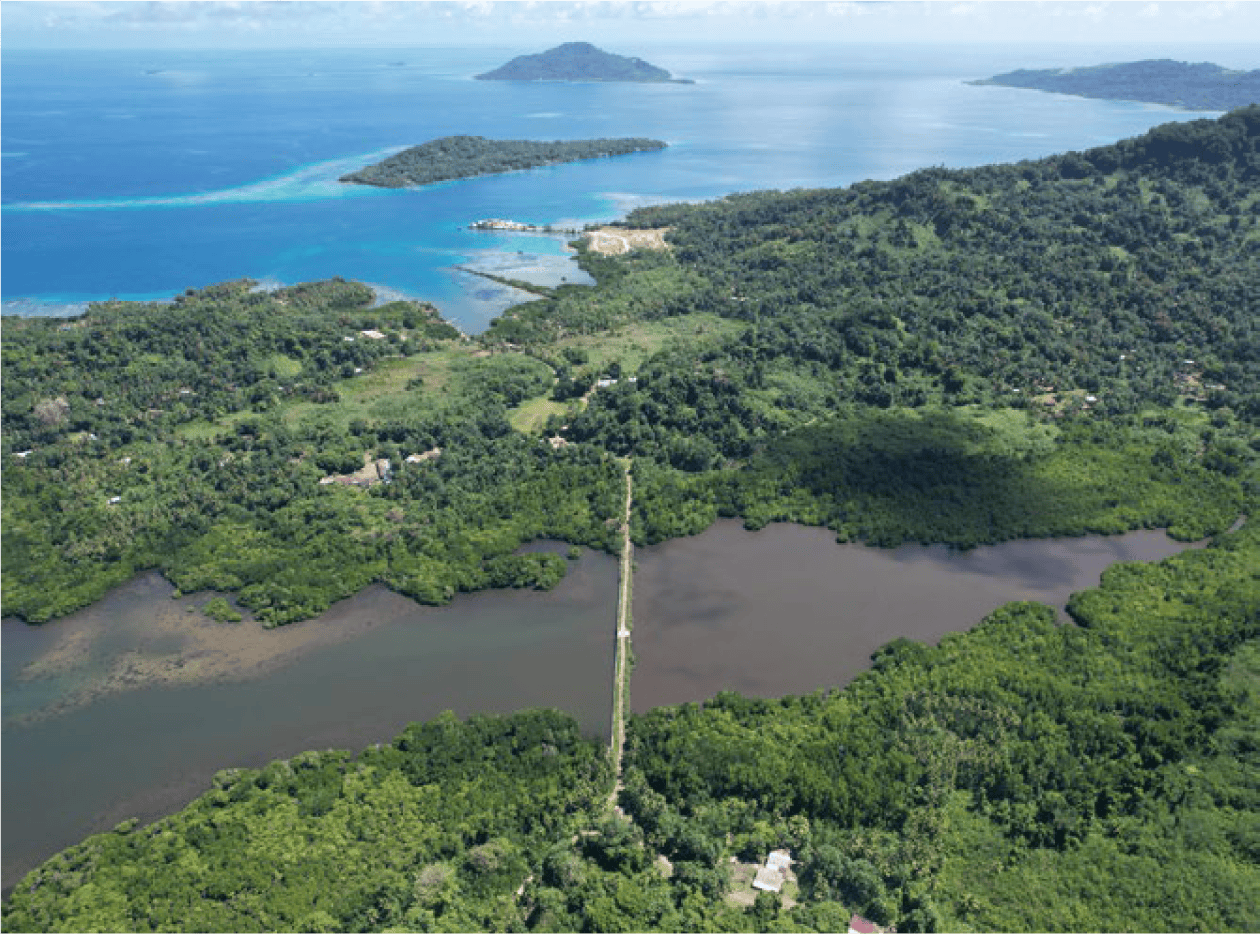
Chuuk Atoll, located in the Caroline Islands, has one of the largest lagoons in the world.

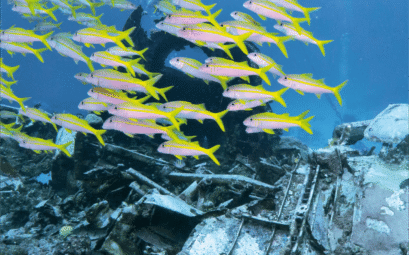
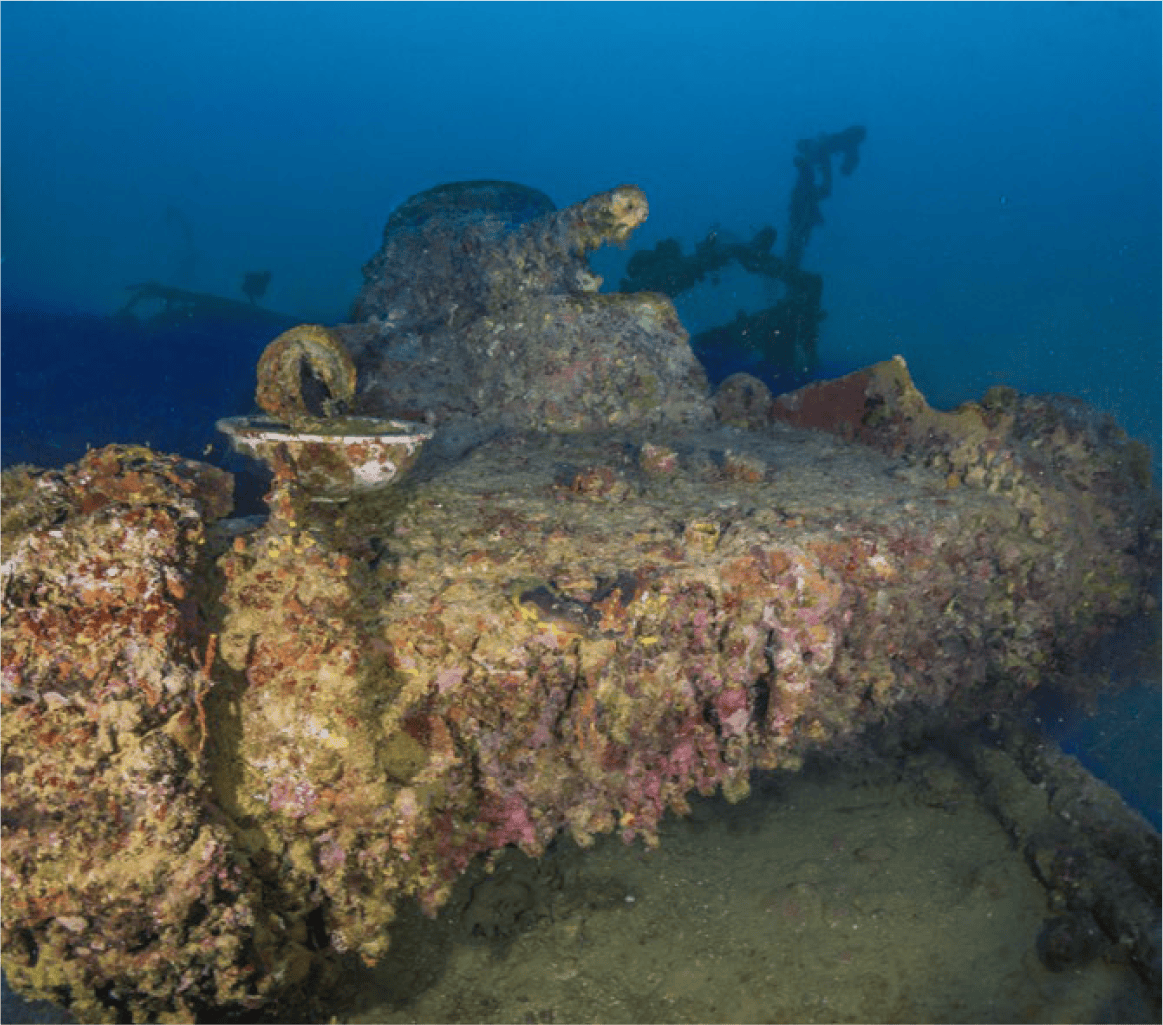
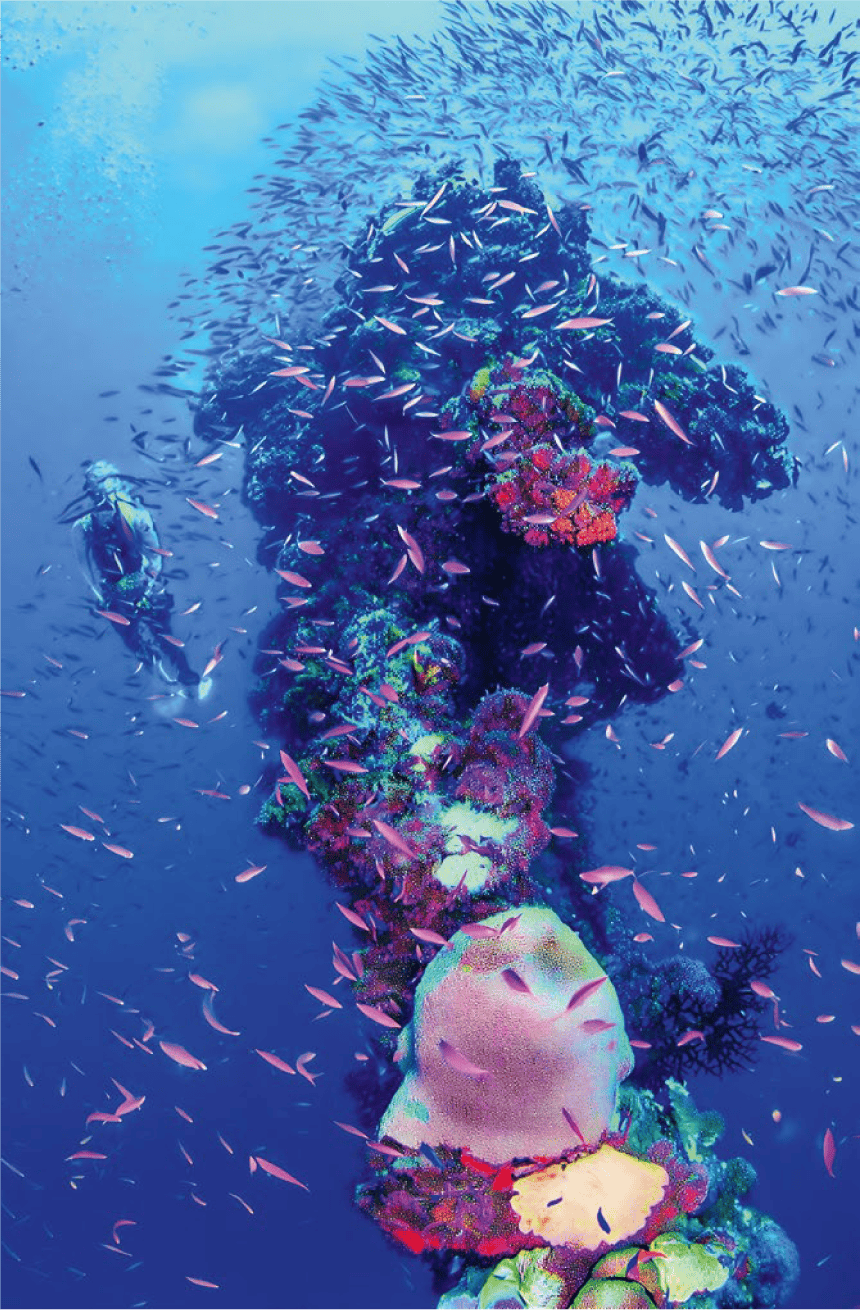
Beneath the blue waters of the lagoon, encrusted with coral, are more than 60 sunken ships from the Japanese WWII fleet. Lashed to the decks of freighters are the rusty remains of fighter planes and trucks.

The lagoon has been declared a monument, with the salvage and taking of relics prohibited by law. Divers must obtain a permit before diving around the ships.

One of the top two scuba diving locations in the world, Chuuk’s water temperatures are 29°C and incredibly calm between the periods of October – November and April to June. The average temperature above water is 30°C.

The main island of Weno is the capital and commercial centre, and Chuuk’s State Centre is where visitors can experience a taste of island life by visiting the local stores jammed with everything from kerosene stoves to ladies’ wear and handicrafts.

VIEWS OF HISTORY

For an outstanding view of Weno and the lagoon climb into the old lighthouse built during the Japanese occupation, and visit the Blue Lagoon Resort for a stroll in the coconut palm grounds with splendid views across the water to Dublon Island, formerly the Japanese military headquarters.

The Japanese Wartime Communications Center is the principal structure in the complex of buildings that now comprise Xavier High School. Built of reinforced concrete with walls three-to-four feet thick, the massive building sustained little damage despite direct hits from US bombers.

The property on which the building stands had been purchased by the Catholic Church prior to the war, and today the complex includes classroom buildings, a chapel, a study hall, and gymnasium.

The Tonata Guns and Caves serve as other reminders of wartime. Japanese Forces fortified many natural caves on Weno and other islands in Chuuk.

The highest peak on Weno is Tonachaw Mountain (also known as Mt Iras) at 229 meters. This mountain is the legendary home of the god Souweras and his divine son. Situated by the Wichon River and Falls, the Wichon Men’s Meeting House is the spot where Weno chiefs are reported to have met with Poowere, eldest of the six brothers who were the first chiefs in one specific ancient system known to ethnographers.

The shallow pool at the base of the Falls is still used for bathing and sport, just as in historic times. Numerous petroglyphs are etched in the exposed basalt above the Falls.

Nefo Cave, just 50 meters from the Governor’s Residence, is about 10 feet wide, 6 feet high and 78 feet long. The cave contains a gun used by Japanese soldiers to guard entry to the north pass, and many soldiers lived there.

Nemwes and Fouman Rocks, in Tunuk and Onip on Udot Island, are associated with the tales of the ancient exchanges between Chuuk and Yap, the island group that lies to the southwest.

Ocean excursions and adventure trips to other pristine locations can be arranged through hotels and the Chuuk Visitors Bureau. Sunrise and sunset cruises of the lagoon or to the outer islands are gladly serviced via small aircrafts within the Caroline Island Air, wings of the Federated States of Micronesia.

NATURAL BEAUTY

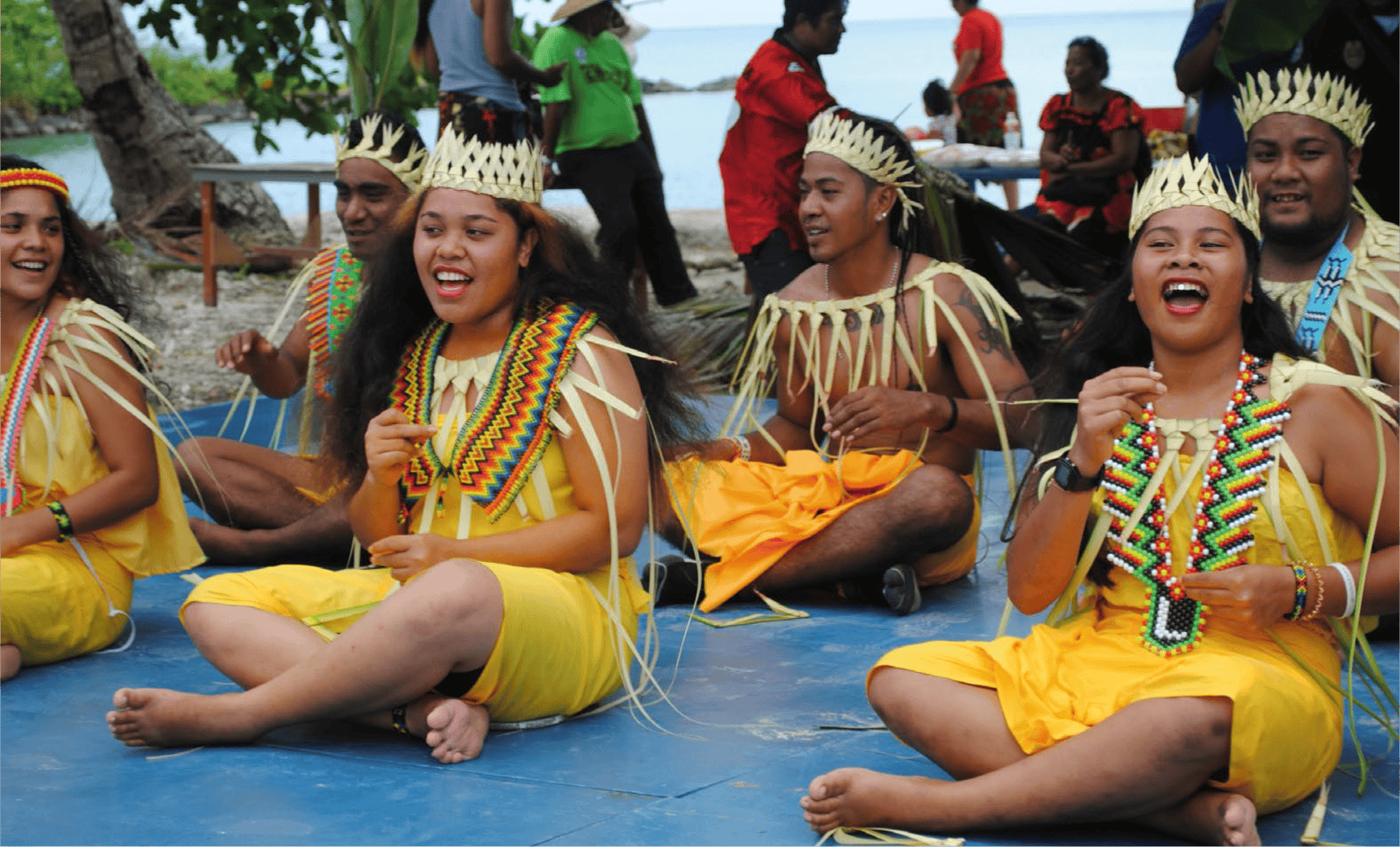
The many islands within this huge atoll are adorned with natural beauty. Many have lush vegetation that shelters rare birds. Wild orchids and other flora are found in the scenic and often rocky terrain. Life here is lived close to nature and in harmony with the land and the sea. For many, fishing, weaving and tending gardens often take over from the subsistence lives on individual islands.

Open hearth fires are still used to cook the meals, especially during festive occasions. Boat makers create vessels high in the hills of the inner islands and take them down to the sea when they’ve finished building them. Carvers here are famous for using beautiful local woods to carve warrior masks and busts. The Chuukese love stick is part of a legendary practice of courtship unique to this island group.

The famous Paata Turtle Cave is a natural structure with an intriguing ancient heritage. Traditional lore describes how it was built by two turtles during prehistoric times, the cave providing a passageway for villagers on Paata Island to bring tributes to their island chief without being terrorized by the massive ghost Oneiap from nearby Oneisomw Island. Before the turtles came to the villagers’ rescue, Oneiap could see from afar and would wade through the ocean between Paata and Oneisomw to snatch the food tributes away to his place, leaving the chief and his people hungry. A magician from the island summoned the two turtles, one male and one female, to help dig the hole through the mountain base to allow movement between villages out of sight of Oneiap. That cave is known today as Fouimw and runs in a straight direction so, depending on where people enter, from east-to-west or west-to-east, directly to the opposite side. It is one of the largest, naturally occurring tunnels in Micronesia.

American dollars are used while traveler’s cheques and currency can be changed at banks and at some hotels. When visiting traditional areas, respect local customs.


Micronesia Mariana Islands Saipan Holiday

Northern Mariana Islands

Here is an interesting fact about the Northern Marianna Islands. The B-29 bombers that dropped the atom bomb on Hiroshima and Nagasaki started their mission from Tinian island, one of the main islands here. The islands are now a part of the United States.

Tourism is the mainstay of these islands which receive a large number of tourists from Japan and neighboring South East Asian countries. The three main islands here are Saipan, Tinian, and Rota (the capital is Saipan, and most tourists arrive here).

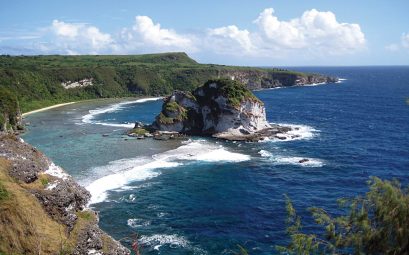
The islands are rich in biodiversity and have lovely beaches with white sand and turquoise blue water (some of the best diving spots in the world are located here as well). There are also a number of historical spots connected with World War 2 here.

Vanuatu

The waters surrounding these beautiful islands provide some of the most spectacular and varied underwater exploration in the South Pacific. Experienced divers come from all over the world to swim amongst the WWII wrecks which lie scattered over the seabed.

A tropical paradise, only three hours from Sydney, Vanuatu means ‘the land that has always existed’.

It is made up of 83 islands formed in a Y-shaped archipelago which stretches over some 1,176 kilometres of the Pacific Ocean, halfway between Australia and Hawaii.

Capital and major centres
Although Captain James Cook explored and chartered the Vanuatu archipelago in 1774, which he named the New Hebrides, he ignored the island of Efate and thus missed discovering one of the world’s most beautiful deep-water harbours. Today Efate offers safe anchorage to those who visit the capital, Port Vila, by boat, and there is Bauerfield, the international plane terminal, which is 10 minutes from the capital. Thus, Port Vila is the gateway to Vanuatu and offers visitors a wealth of tourist activities.

Free of skyscrapers, the town is set within a magnificent natural harbour, hibiscus dot the surrounding hills and the air is redolent with the scent of frangipani. A boat trip around Efate and the other island retreats reveals a place untouched by modern civilisation.

Tanna Island has almost 28,200 people who inhabit 92 villages in a 565-square kilometre area. The islanders have remained relatively unchanged by a century-and-a-half of explorers, missionaries and traders. Pentecost Island is a beautiful unspoilt place, home to a spectacular ritual, Naghol. Espiritu Santo is the largest and oldest island with the largest population and the greatest number of natural sights.

The movie South Pacific was inspired by this island and Bali Hai is named after Ambae, located to the east of Espiritu Santo.

The people
Predominantly Melanesian, the people speak English, French and Bislama, a form of pidgin English. The Ni-Vanuatu have populated these islands for centuries and with more than 115 distinctly different cultures and languages still thriving, Vanuatu is recognised as one of the most culturally diverse countries in the world.

History
The first European to visit these shores was Spanish navigator Fernandes de Quiros who landed at Big Bay on Espiritu Santo in 1606. The French explorer, Bougainville, arrived almost 160 years later and in 1774 Captain James Cook charted all the islands and named the archipelago the New Hebrides. In 1839 missionary John Williams attempted to impose Western ways and Christianity on the Ni-Vanuatu and was clubbed to death and eaten. However, the locals had no defences against the slave traders, known as black birders, who shanghaied more than 40,000 people to work on the sugar plantations in Australia.

In the 1860s, British and French interests purchased huge tracts of land for cotton plantations and the Ni-Vanuatu retaliated by killing a number of Europeans, only to suffer extensive naval bombardment of their villages. The French and British jointly colonised the islands in 1906.

During WWII, the 250,000 Americans stationed in Vanuatu brought in enormous amounts of cargo which led the Ni-Vanuatu to believe that such vast wealth could only have come from the gods. The New Hebrides gained its independence in July 1980 and was renamed Vanuatu.

Nature
Vanuatu has rich lush tropical rainforests, volcanoes, sparkling blue lagoons, cascading waterfalls and beaches that range from silky white to volcanic black. Surrounding the land is a magic sea of aqua and dark blues with a fascinating underwater world of colourful tropical fish that live amongst magnificent coral reef formations.

The sights
Port Vila offers a range of resorts and scenic bus tours, island cruises and flights around the archipelago. Away from the capital you have the opportunity to visit villages, bathe in hot mineral springs and shower beneath sparkling waterfalls. To familiarise yourself with the town, take a half day bus tour, or if you are feeling adventurous catch a local bus. Visit the Vanuatu Cultural Centre and Museum where you’ll see a wonderful display of artefacts and photographs.

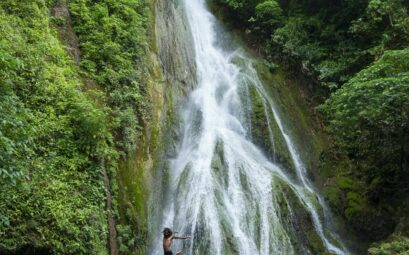
Outside the town, hire a car or four-wheel drive and explore the old manganese mine, the magnificent tropical rainforest and friendly villages like Erakor Village. Siviri village’s famous cave is where the children magically beat the earth to light the inside, and Havannah Harbour once played host to the US 7th Fleet during WWII. Eton beach is a favourite, and so too are the Cascades Waterfalls, a series of small waterfalls and pools, some of which you can swim in. Mount Erskine, 25 kilometres from Port Vila, is accessible only by 4WD. From the summit, on a clear day, it is possible to see other islands in the archipelago.

On Espiritu Santo, visit major plantations growing cocoa, coffee and coconuts and explore the world’s most accessible passenger liner, the SS President Coolidge, wrecked in Santo Harbour. On Tanna island, the active Yasur volcano provides spectacular displays and it is possible to venture to the crater edge. Pentecost Island is renowned for the antics of its young men who hurl themselves off 30-metre high towers with forest vines attached to their ankles in a celebration of the yam harvest.

Where to stay
Vanuatu has a wide variety of hotels, popular resorts, guesthouses and thatched bungalows on offer to cater for those looking for luxury accommodation to the budget conscious traveller.

Getting around
Organised tours are easily joined in Port Vila. Car rental is an option, and as the roads are rough outside the city, four-wheel drive vehicles are recommended. In Port Vila, a minibus service covers three routes from sunrise to sunset and taxis operate 24-hours.

Food and entertainment
Port Vila offers outdoor cafes, a casino, discos and bars. A favourite is a barbecue at some of the resorts on weekdays where succulent local steaks, fresh fish, kebabs and a wide selection of fresh vegetables, salads and pastries are served. All major hotels have regular entertainment. International cuisine features strongly with French, Polynesian, Indian, Chinese, Vietnamese, English and Japanese to choose from, as well as delicious local specialties such as wild pigeon and flying fox cooked island-style in ground ovens.

The men of Vanuatu drink kava at local kava bars and there are regular Melanesian cultural shows.

There is an abundance of water sports with excellent reef and wreck diving in Efate and Santo (living aboard the dive boats).

Other activities include golf in Port Vila, tennis, big game fishing, river and ocean kayaking, horse-riding, ziplining and cycling.

Islands of Tahiti

Officially known as French Polynesia, The Islands of Tahiti are made up of 118 islands spread over four thousand square kilometres of ocean in the eastern South Pacific. The islands are further grouped into five archipelagos: the Society Islands, Austral Islands, Marquesas Islands, Tuamotu Islands and Gambier Islands.

Capital and major centres
Papeete is the capital of Tahiti, the largest island within French Polynesia, dubbed the Mother Island. The country’s only international airport, Faa’a is located on the island, making Tahiti the first stop in every itinerary. Moorea is Tahiti’s closest neighbouring island, some 17 kilometres north-west of Papeete. Heart-shaped Moorea is home to soaring volcanic peaks and magnificent views overlooking the tranquil waters of Cooks Bay and Opunohu Bay.

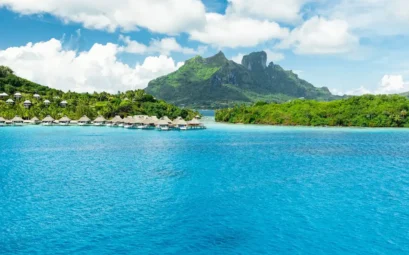
The Society Islands also include the legendary Bora Bora, 240 kilometres northwest of Tahiti, as well as Huahine, comprised of two islands joined by a narrow isthmus and enclosed by a protective necklace of coral.

Rangiroa and Tikehau are the best-known islands in the Tuamotu archipelago. Rangiroa is the largest atoll in the Tuamotus, encircling a 67-kilometre turquoise lagoon famed for its rich diversity of marine life.

Tikehau has an almost perfectly circular shape, with its many atolls surrounding a lagoon that extends 26 kilometres across.

Some other lesser-known islands worth exploring include every diver’s paradise Fakarava island, which has been declared a UNESCO Biosphere Reserve and is known for its incredible underwater world, the majestic islands in the Marquesas archipelago such as Nuku Hiva with its dramatic volcanic peaks and rugged landscape and Hiva Oa, which is the home of the largest tiki statues in French Polynesia. These lesser-known islands offer a very authentic look into the old Polynesia.

For an even more remote experience, travellers can explore islands such as Rurutu and Rimatara in the Austral Archipelago, which is often considered a very untouched and mysterious land and is one of the best places in the destination to swim with humpback whales.

The people
The population of The Islands of Tahiti is a multicultural mix of Polynesians of ma’ohi (Maori) extraction, Europeans and Asians. They are noted for their hospitality, friendliness and easy-going nature. French and Tahitian are the two official languages on the islands, however English is widely spoken in hotels and shops.

The Tahitians still today embody their rich and expressive culture from their ma’ohi ancestors, where music, dance and art of the past is very much part of Tahitians everyday life. The power of Mana is the sacred force of the Tahitian life and links all living things, past and present.

History
Hundreds of years after the ancient Polynesians made the Tahitian islands their home, explorers like Mendana, Quiros, Le Maire, Schouten, Roggeveen and Byron made brief and unplanned visits to the Tuamotu Islands and the Marquesas islands in the 16th, 17th and 18th centuries. Later in the 18th century explorers such as Bougainville, Wallis, Vancouver and Cook ‘discovered’ Tahiti and called it ‘La Nouvelle Cythère’.

Captain Cook returned three times to study the transition of Venus, Captain Bligh came to collect seedlings from the wondrous ‘Uru’ or breadfruit tree, and the insubordinate Fletcher Christian returned to the islands following the infamous mutiny on the Bounty.

Before the arrival of the Europeans, the islands were divided into districts, each governed by a chief. When King Pomare V abdicated in 1880, The Islands of Tahiti, previously a protectorate of France, became a French colony, and in 1958 reconstituted as a French Overseas Territory and renamed French Polynesia. In 2004, French Polynesia became an Overseas Country withing the French Republic with self-governing powers and a mission to provide for her people through commerce and investment.

Nature
With its 118 islands spread across such a wide area, the islands consist of a mix of islands with dramatic high volcanic peaks and low-lying atolls. There’s a beautiful contrast between the lush vegetation growing high above the lagoons and bays and there’s a floral scent permeating the tropical air.

A myriad of tropical flowers grow throughout The Islands of Tahiti. The national flower is the tiare, a heavily scented gardenia that forms the basis of the traditional lei necklaces.

The sights
You can visit Point Venus where Captain Cook camped to observe the transit of the planet Venus in 1769, visit the Faaruma waterfalls, and at Taravao on the strategic isthmus joining Tahiti Nui and Tahiti Iti, wander through an old fort built by the French in 1844.

Don’t miss the Gauguin Museum in the Papeari district, set in exotic botanical gardens, and the wonderful fruit, vegetable and flower market in central Papeete.

Another noteworthy spot is the Musee de Tahiti et des îles – Te Fare Manaha, which is a collection of important artefacts of the Polynesian culture and history.

Food and entertainment
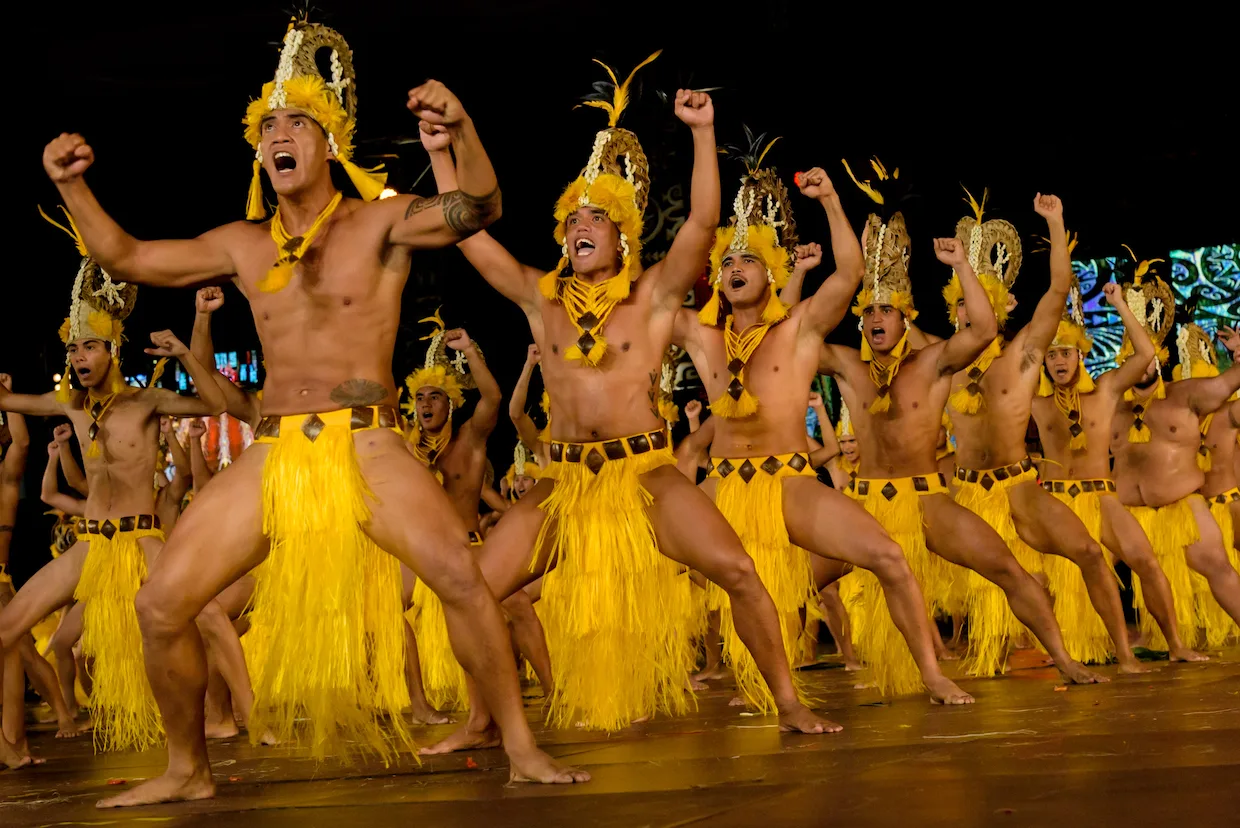
Tahitian tamara’a’ or feasts can be arranged through local tour operators. The major international hotels often host evening programs with lavish buffets and dance shows featuring the performances of some of Tahiti’s most talented dancers and musicians. Outside the hotels, French, Italian and Chinese cuisine is widely available. There are a host of bars, cafes and nightclubs scattered around Papeete giving travellers a wide choice and a chance to mix with the locals. Dotted around the capital and down in the marina is a range of food trucks offering where you can try a wide selection of food the locals love.

Must-try dishes in The Islands of Tahiti include the national dish poisson cru, which is a mix of raw tuna marinated in lime juice and coconut milk, chicken fáfá with taro leaves and other dishes cooked in a traditional ahima’a (Polynesian underground oven).

Where to stay
International luxury resorts and hotels nestle alongside lodges on the islands. For an authentic Tahitian experience, many families also offer rooms for rent within their homes also referred to pensions or guesthouses. There are also youth hostels and campsites with cooking facilities for those on a tight budget. For larger groups or families, renting a vacation home is also a great alternative.

Getting around
Le Truck is Tahiti’s public bus service. The destination is posted on top of each Le Truck, which always begins and ends its round trips at the public market in the centre of Papeete. It is also possible to travel between islands by ferry, with the Aremiti ferry taking just 40 minutes from Papeete to Moorea.

Activities
Tahiti is renowned for its range of water sports, from diving and snorkelling, to windsurfing and sailing, to deep-sea fishing, surfing and jet-skiing. Speedboats are available for waterskiing and there are glass-bottom boats for viewing the coral reefs. Tennis and squash are on offer at many resorts and at the country club and Tahiti and Moorea offer championship golf courses.

For the more adventurous, there’s a range of bushwalking and hiking available on the volcanic islands of the Society Islands, as well as horse-riding.

Shopping guide
Bright pareus (Tahitian sarong) or T-shirts are popular souvenirs, as are Tahitian shell jewellery, the famous black pearls, French perfume and local handicrafts.

Climate
The French Polynesian islands enjoy a tropical climate. The average temperature is 27ºC, and the waters of the lagoons are a fairly constant 26ºC.

Clothing
Casual. Pareus are popular worn over swimming costumes to the beach or around the pool. Papeete is more cosmopolitan.

Electricity
Most hotels use 110 or 220 volts, AC 60 cycles.

Time zone
GMT10 hours. AEDT 20 hours. Two hours behind US Pacific Standard time and 21 hours behind Australia’s east coast. The Marquesas Islands are 30 minutes ahead of the rest of French Polynesia.

Currency
Central Pacific franc (XPF). Tipping is discretionary.

Visas and health
All passengers entering French Polynesia must have an outbound ticket. Check with airline as entry formalities may change.
There is no departure tax and Australians do not require visas. Other visitors, check with the French Consulate.

Getting there
Air France, Hawaiian Airlines, Air New Zealand, QANTAS, LanChile (via Easter Island), Air Caledonie International and Air Tahiti Nui. The domestic carrier is Air Tahiti.

Honiara

Honiara, the capital of the Solomon Islands, which is situated on Guadalcanal, has a population of more than 130,200 and is located on a coastal stretch overlooking Iron Bottom Sound.

The town centre has a shopping plaza, cafés, restaurants and souvenir shops and, of course, the Central Markets. Major meeting places can be found in private clubs that welcome visitors.

The Mataniko Falls, a two-hour walk from Honiara, has pools for swimming and an impressive stalagmite-covered cave which is home to vast numbers of swallows.

Climb Mount Austin, passing Solomon Peace Memorial Park, for sweeping views of the northern coastal plains. Other historic sites include the Red Beach on the coastal plain.

East of Tenaru is the Tenaru Falls, an impressive 60-metre waterfall. And situated in a westerly direction from Honiara town is Bonegi Beach, five kilometres west of Poha. At the eastern end of Guadalcanal is Marau Sound, a coral paradise. Here there are huge reefs of coral in unique and beautiful shapes which are home to a teeming array of tropical fish and fascinating sea life. There are also giant clams and some of the world’s rarest sea shells.

About 250 kilometres south of Guadalcanal is Rennell Island. On the south side of the island, the large Lake Tengano contains some 200 tiny coral atolls and is home to a prolific bird population. Access to the lake is by tractor, canoe and jungle walk.

The Florida Islands are the closest island group to Guadalcanal and was the pre-war Solomon capital of Tulagi. It was turned into a navy shipbuilding and repair facility during the war.

Savo Island is a cloud-shrouded place, and its waters house the graves of at least four ships that were sunk during the Battle of Savo. Today it is an ideal picnic spot and a divers’ paradise with its sunken ships, sleepy villages and magnificent crystal-clear waters.


Solomon Islands

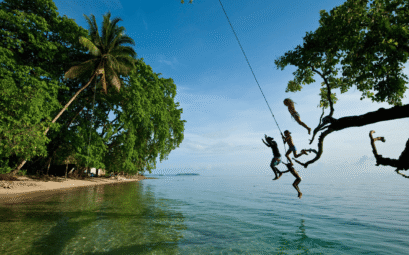
Virtually untouched by commercial development, theSolomon Islands are a natural paradise located south-east of Papua New Guinea and only three hours by air from Brisbane, Australia.

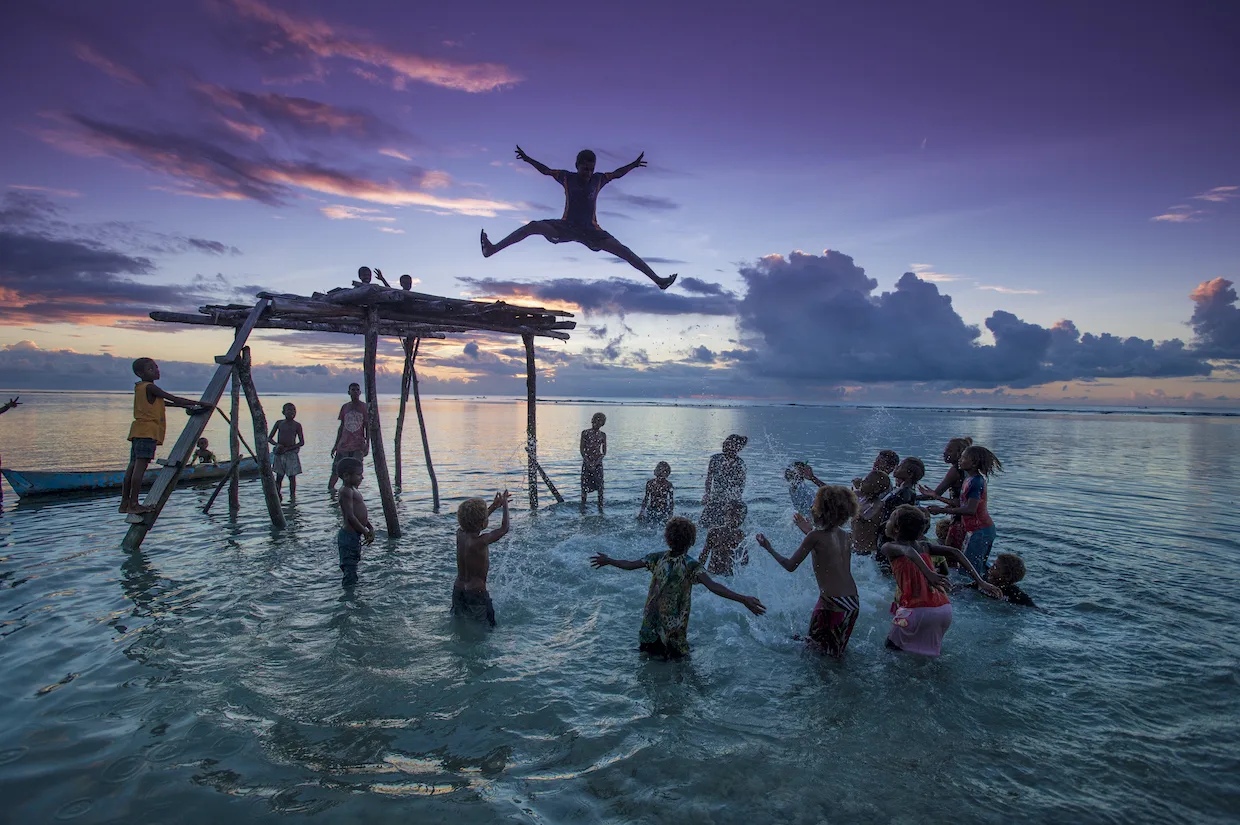
The people of the Solomons still practise a traditional way of life, preferring to respect the old customs and traditions. They believe in maintaining and preserving their beautiful unspoiled environment.

Capital and places to visit
The Solomon Islands are geographically fragmented with nine main provinces: Choiseul, Guadalcanal, Santa Isabel, San Cristobal, Malaita, Western, Temotu, Renbel, Central Province and the capital is Honiara.

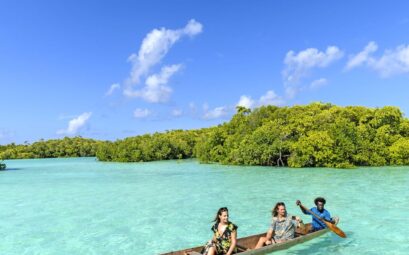
The Western Province is perhaps the most visited region of the Solomons and its centrepiece is the largest, double barrier lagoon in the world, Marovo Lagoon, that has been nominated for World Heritage listing. Literally thousands of islands scatter the lagoon, from tiny coral islets on the fringing reef to massive 1600-metre volcanic islands. Some are still active and can be visited such as Simbo as well as the undersea volcanoes near Ngattokae. Inside the lagoon, the islands are surrounded by spectacular coral formations and white sand beach.

All the facilities needed by modern visitors are available in the quiet, peaceful town of Gizo, the capital, and surrounds. There are banks, luxury hotels, guesthouses and backpacker accommodation, bars and restaurants.

The province offers traditional villages, secluded beaches, superb snorkelling and scuba diving where you can explore the watery graves of undisturbed WWII relics.

The people
The islanders are smiling, warm, friendly people, mostly Melanesians (90 percent), with some Polynesians, Micronesians, Europeans, and Asians. English is the official language, though there are more than 120 indigenous languages.

History
It is believed that the Austronesians discovered the Solomon Islands about five thousand years ago and Melanesian hunter and gatherer voyagers first settled in the larger islands. Polynesians known as the seafarers later arrived and settled in the smaller islands and atolls that border Solomon Islands’ northern and eastern boundaries.

The Spanish were the first Europeans to visit the islands, Alvaro de Mendana naming them the Solomons. Some of the fiercest fighting of WWII took place in and around Honiara and names such as Bloody Ridge, Red Beach, Skyline Ridge and Henderson Field will live long in the memories of both sides of the conflict. Here in 1942, the bloodiest and longest campaign saw the loss of nearly 38,000 lives and the turning point of the war in the Pacific. There are many battle sites and relics of the war to be found not only here, but throughout the islands.

The Solomon Islands became a fully independent nation in 1978 and today the country operates under a provincial government system of nine provinces. The national parliament adopted a Westminster system and has a democracy-style government.

Nature
The Solomon Islands’ archipelago offers one of the richest underwater worlds on the earth and boasts kilometres of deserted sandy beaches and an unparalleled sense of calm. Lush tropical rainforests cover most of the island group. Exotic orchids, ferns and palms are found everywhere and butterflies and exotic birds are abundant while a variety of trees and shrubs have been introduced along with fruits and vegetables.

The sights
With more than 300 days of perfect weather each year, this is plenty to do in this tropical paradise.

In Honiara, take time to visit the intact WWII relics of fighter planes, tanks and machine guns slowly rusting in peace as well as Japanese and American war memorials. Learn a little about the history of the Solomon Islands and visit the old hanging site, a relic from the British colonial past.

The National Museum is located in Honiara and the Honiara main market is a good place to find local bargains. The Western Province offers traditional villages, secluded beaches, superb snorkelling and scuba diving where you can explore the watery graves of undisturbed relics from the war.

Day trips to the Central Islands can be easily arranged and Malaita province is also a must-visit.

Where to stay
Wherever you choose to stay, be sure to learn from your hosts a little of the their culture and religion. Depending on your budget you can stay in a premier hotel, in apartments, rest houses, village resorts or in cabins or lodges.

You can unwind in a locally built cabin perched over a pristine lagoon or relax in a self-contained bungalow on the edge of a sandy beach or be mesmerised by the views over the archipelago’s crystal-clear waters from one of the resorts. Those truly wishing to immerse themselves in the local culture may choose a village stay where they can live in a local community and experience the local life first hand.

Getting around
There are public buses, hire cars, taxis – which cost $10 per km, and you can see a lot simply by walking. Interisland travel is available by either by aircraft or boat. Solomon Airlines flies to about 20 destinations throughout the country. They are also available for charter. For those with more leisure time, an interesting option is to travel by passenger vessel.

Activities
There are plenty of activities to keep visitors active and most are aquatic based including world-class surfing, swimming, sailing, windsurfing, waterskiing, game fishing and snorkelling. The islands are renowned as a scuba diver’s paradise with coral, shipwrecks, giant clams, tropical fish and game fish.

Golf, tennis and bushwalking are also offered or trek to Savo, the active volcano just 45 minutes from Honiara. Enjoy a visit to the ingenious man-made islands of the Lau and Langalanga people. There is plenty to do!

Food and entertainment
Major hotels have restaurants and there are international restaurants in Honiara. Hotels have beer gardens and bars and several private clubs welcome visitors. Regular island night barbecues are very popular.

Currency
The local currency is Solomon Island dollars. (SBD) Tipping is not encouraged and visitors are usually asked to refrain from the temptation to do so due to Islanders’ pride and custom.

Climate
The climate is tropical with an average temperature of 29°C. November to April is wetter.

Clothing
Casual wear is widely acceptable though brief swimwear should be limited to beaches.

Getting there
International airlines flying to the Solomon Islands include Solomon Airlines, Qantas, Fiji Airways and Air Niugini.

Shopping guide
High quality craftwork is available and includes ebony and ‘kerosene’ wood carvings, bowls with mother-of-pearl inlays, shell jewellery, baskets, bags, hats and mats woven from pandanus or coconut palm. Although the only craft shops are in Honiara, you can buy work direct from craftsmen and women on the other islands. Daily markets are held throughout the islands and the largest and most colourful market is the bustling Central Market in the capital, Honiara.